
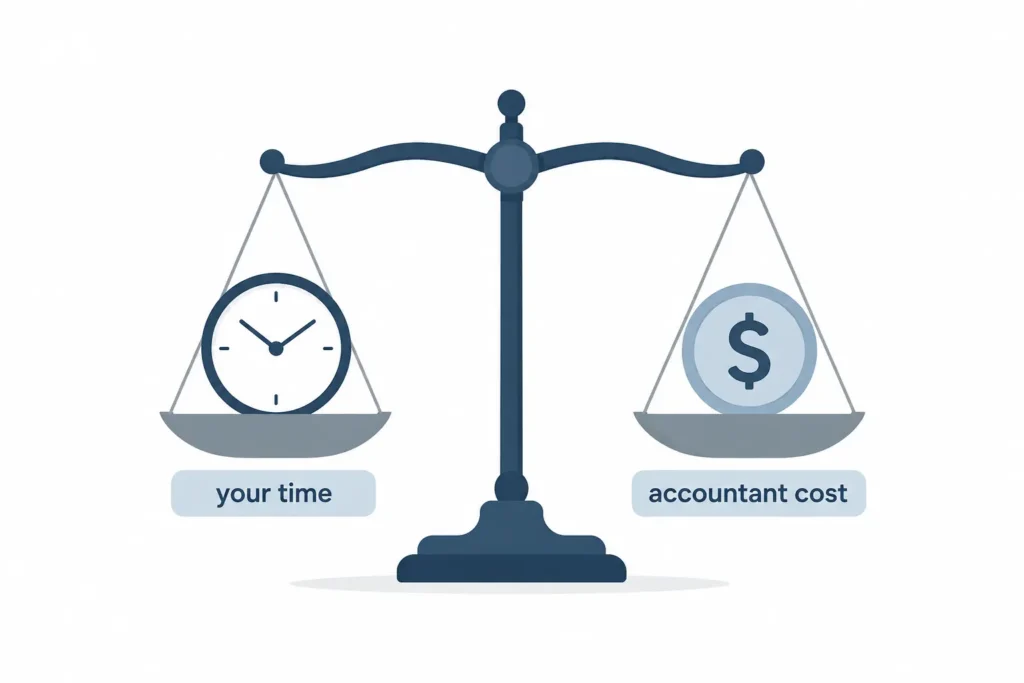
For most small businesses, yes: hiring an online accountant becomes worthwhile once the value of the time you spend managing your own accounts exceeds what the service costs. For a lot of businesses, that point arrives sooner than they expect.
It sounds straightforward, yet very few business owners actually run the numbers before deciding. Most rely on instinct instead: they hire an accountant because the bookkeeping has become a nuisance, or they keep doing it themselves because the monthly fee looks steep on paper, without ever working out what their own time is actually costing them.
A more reliable approach is to work out your own break-even point. The calculation below lets you weigh the value of your time against the real cost of an online accounting service, and gives you a clear, personal answer instead of a guess.
The break-even calculation
Weighing “time saved” against “cost” only works once you know what your time is actually worth. Here’s how to work that out.
Step 1: Work out what your time is worth
Take your business’s monthly profit, not its revenue, and divide it by the number of hours you personally work in the business each month. That gives you a rough effective hourly rate for your own time.
For example, say your business generates £4,000 in profit each month and you work 160 hours a month:
£4,000 ÷ 160 = £25 per hour
On those figures, an hour of your time is worth roughly £25 to the business. This isn’t your salary or a formal measure of productivity, it’s simply a useful benchmark for deciding whether a given task is worth doing yourself.
Step 2: Calculate how much time you spend on your accounts
Work out how many hours you spend each month on bookkeeping and related tasks. This is where people tend to underestimate. Don’t count only data entry and reconciliation, include the less obvious work too: chasing receipts, correcting categorisation errors, preparing VAT returns, and the time lost stopping mid-task to work out where a transaction belongs.
Say that adds up to six hours a month.
Step 3: Put a monetary value on that time
Multiply the hours by your hourly rate:
6 hours × £25 = £150 per month
That’s what your own time is effectively costing the business when you handle the bookkeeping yourself.
Step 4: Compare that figure with the accountant’s fee
Now weigh your £150 monthly time cost against what an online accounting service would actually charge. If a fixed-fee package for your type of business runs £120–£180 a month, you’re roughly at break-even. At that point the decision stops being purely financial, it comes down to fewer errors, less admin, and the hours you get back to spend running the business instead.
The picture looks very different if your own time is costing the business £400 a month and the service costs £150. You’d be spending £400 worth of your own time to avoid paying £150 for someone else’s. The case for outsourcing gets a lot stronger, fast.
The example above uses round numbers to keep the maths easy to follow. Run it with your actual profit, your actual hours, and a real quote, and the answer gets a lot more useful. If you’d rather skip the guesswork, send us your numbers and we’ll work out your break-even point with you, free of charge.
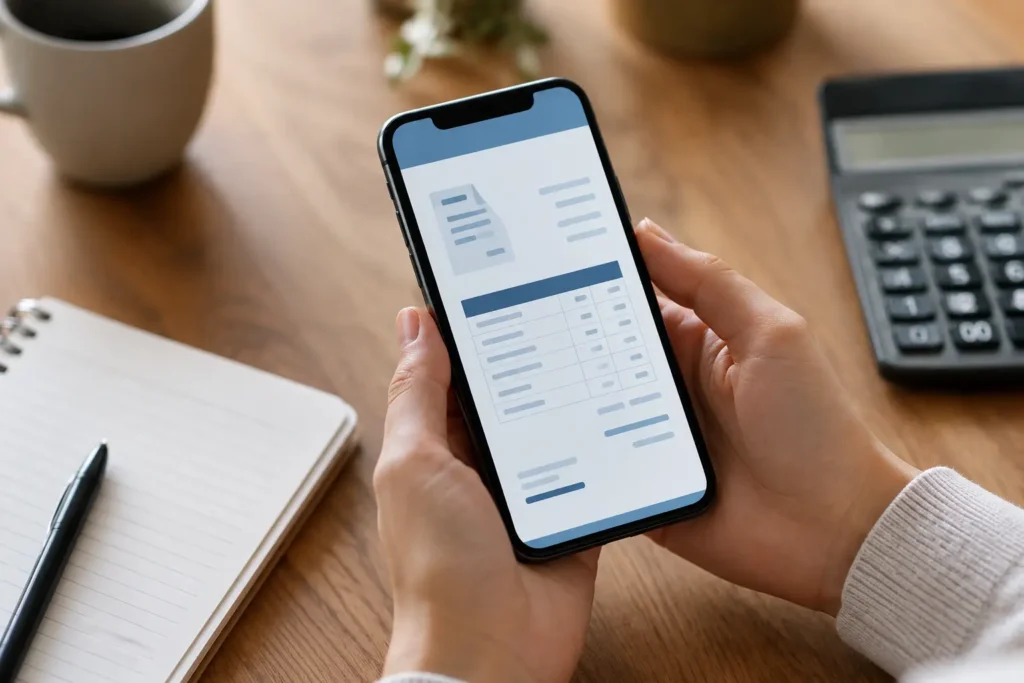
What an online accountant actually costs in the UK right now
Online accounting fees have shifted quite a bit in 2026. Whether you’re VAT-registered, whether you run payroll, and what kind of business you operate all move the price noticeably.
| Business type | Typical monthly cost (online, fixed-fee) | What’s usually included |
| Sole trader, not VAT-registered | £50–£100 | Bookkeeping, Self Assessment, basic advice |
| Sole trader, VAT-registered | £100–£150 | Above, plus quarterly VAT returns under MTD |
| Small limited company, no payroll | £100–£250 | Bookkeeping, annual accounts, Corporation Tax, VAT |
| Small limited company with payroll (1–5 staff) | £150–£300 | Above, plus payroll processing |
| Contractor affected by IR35 | £70–£150 | Compliance work plus IR35-specific advice |
These figures are only useful if you’re comparing like with like. The accountant’s monthly fee usually isn’t the full cost of running your accounts, most businesses also pay separately for cloud accounting software. Something like Xero typically runs £16–£65 a month depending on the plan. Some online accountants fold that into their fee; others bill it separately.
That distinction matters more than it looks. A firm charging £99 a month without software included can end up costing more than one charging £130 a month with software built in. Check exactly what’s covered before comparing two quotes side by side, or ask us to walk through a quote you’ve already received.
What separates a good online accountant from a weak one
The online model works extremely well for small businesses when it’s set up properly. Where it falls short usually comes down to the provider, not the format itself.
A good online accountant gets these right:
- Predictable pricing. A fixed monthly fee, with no surprise invoice after a “quick call.”
- Fast, direct communication. You should hear back the same day, not whenever someone gets round to checking a shared inbox.
- A named contact who knows your business. Not a rotating pool of junior staff, someone who actually remembers your last conversation.
- Real-time visibility into your numbers. With cloud software behind the service, you should be able to check your position whenever you want, not just at year-end.
- A process built for the way information actually reaches them. If your business still runs on paper invoices from suppliers, a good provider will help you set up a simple capture process rather than leaving you to figure it out.
- Genuine judgement, not just data entry. For anything involving HMRC correspondence, a sale, or a complicated structure, you want someone who picks up the phone and talks it through, not just a portal.
If a provider is missing more than one or two of these, that’s worth noticing before you sign anything, whoever you end up choosing.
Red flags to watch for
- No named, qualified contact. If a firm can’t give you a straight answer to “who exactly will be handling my accounts, and what qualifications do they hold,” treat that as a warning sign. Some online accounting services are really bookkeeping services, and may not employ qualified accountants at all.
- You can’t easily export your data. Before committing, ask precisely how you’d retrieve your financial records if you left. A vague answer is worth paying attention to, difficulty getting your own data back is an unnecessary lock-in risk.
- The headline fee excludes most of what you’ll need. Some providers quote an attractive monthly price because it only covers the statutory basics. VAT queries, payroll amendments, HMRC correspondence, and other routine tasks then get billed separately. A low fee isn’t much use if every ordinary request produces another invoice.
- No real grip on UK-specific requirements. Some “online accountant” platforms are white-labelled services operating from outside the UK, offering fairly generic advice. Make sure whoever you choose understands Making Tax Digital, UK VAT thresholds, and Companies House filing rules specifically, general accounting knowledge isn’t enough here.
This is exactly why, at M&M Finance Advisory, you know who’s working on your account, what’s included in your fee, and how to get your data whenever you need it, no exceptions, no fine print.
So, is an online accountant worth it?
Run the break-even calculation above with your own figures. For most businesses that are VAT-registered, running payroll, or simply spending more than a couple of hours a month wrestling with their books, the answer comes out clearly in favour of outsourcing, both financially and in terms of stress saved.
Even if you’re not sure which side of the line your business falls on, it’s worth finding out properly rather than guessing. A short conversation is usually enough to tell you whether the timing makes sense, and there’s no cost or obligation in asking.
Frequently asked questions
Is an online accountant cheaper than a traditional accountant?
Usually, yes, largely because online firms carry lower office overheads. That gap has narrowed since 2024 though, as more traditional practices have moved clients onto cloud-based systems too. These days, what matters more is what you’re actually getting for the fee, the online-versus-in-person distinction counts for less than it used to.
Can an online accountant handle my VAT returns and payroll?
Yes. These are standard services across most online accounting packages in the UK, typically handled through cloud software like Xero or QuickBooks, with VAT returns filed straight to HMRC.
Is it safe to give an online accountant access to my bank data?
Reputable online accountants use read-only bank feeds through regulated software platforms, they can see your transactions but can’t move money. Ask exactly how the bank connection works and what access level it gives them before assuming.
What size business is too small for an online accountant?
There’s no useful size cutoff, time is a better measure than turnover. Even businesses spending just a couple of hours a month on their books often find that the accuracy, tax planning, and peace of mind more than justify the fee. The best way to know for sure is a quick, no-obligation review rather than guessing from the outside.
Want to know exactly where your business stands? Talk to us and we’ll work through your break-even numbers with you, then build a bookkeeping, VAT, and virtual CFO package around how your business actually runs.